What Chelsea Should Actually Do This Summer
The target system
The picture below is the XI Alonso wants Chelsea to look like. The last side he built like this went unbeaten in the Bundesliga, scored 89, and conceded 24.
The gap
Chelsea finished 2025–26 in 10th — scored 58, conceded 52, finished on 52 points. Three head coaches, one of them caretaker. Champions clearly need to score over 80 in a season for a confirmed title; Chelsea didn’t come close at either end. The gap isn’t squad versus squad; it’s two different ideas of football. What follows is what closing it costs in transfers, position by position.
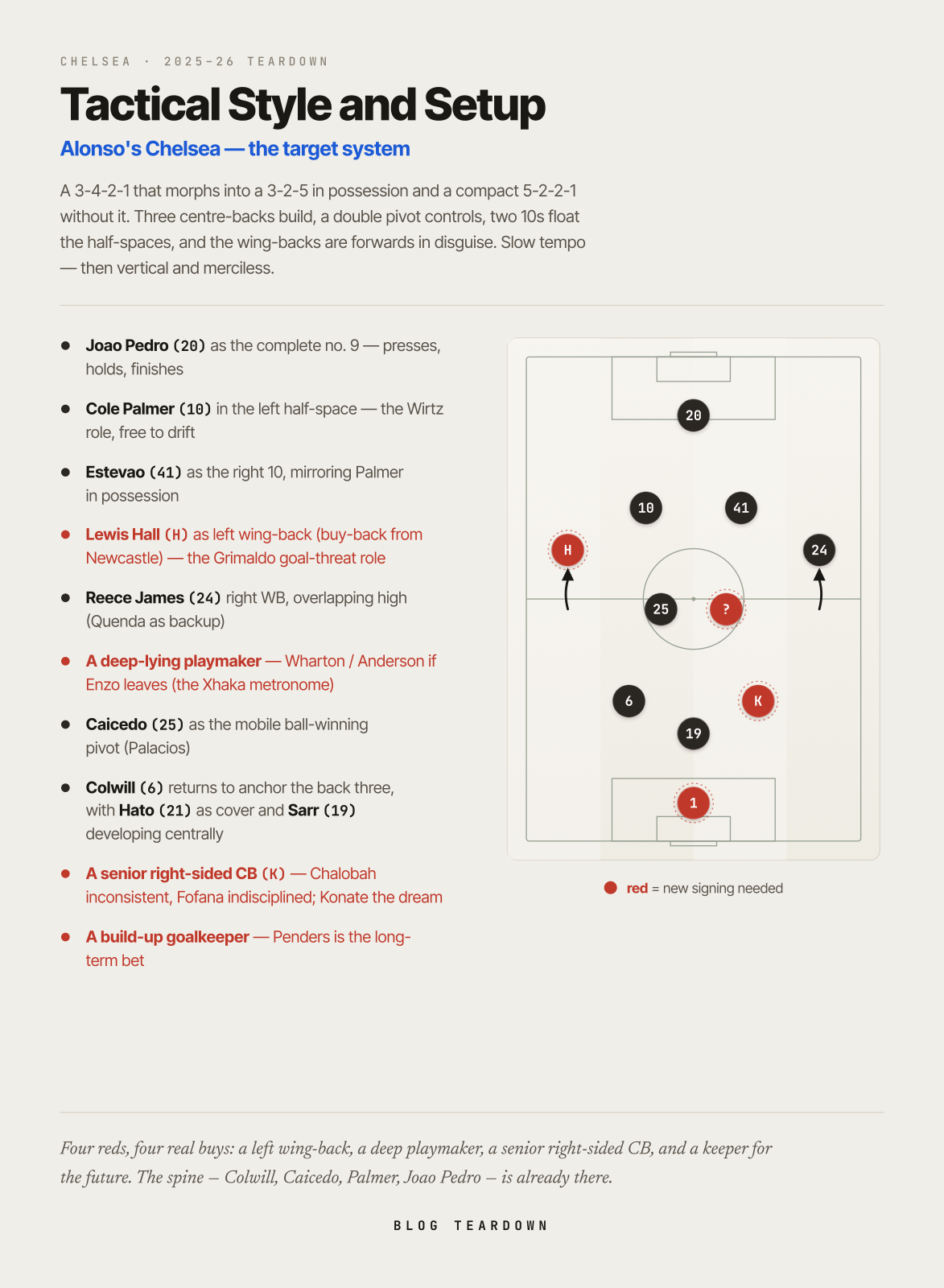
Goalkeeper — transition, not transformation
Robert Sánchez is the established #1. Behind him, Mike Penders — the £17m summer 2025 signing from Genk — was bought specifically as Sánchez’s long-term replacement. Gabriel Slonina sits third on the depth chart, contracted but unplayed this season. Filip Jörgensen, 24 and used as the cup keeper, is the rotation expense Alonso doesn’t need.
Transition phase. Keep Sánchez, Penders, and Slonina; let Jörgensen go and route his minutes to Penders developing through cup ties. No external buy. The keeper transformation moment passed when Chelsea wouldn’t move on Mike Maignan’s €30m valuation last summer.
Centre-back — depth is there, the senior partner isn’t
52 conceded is the audit. Alonso’s Leverkusen back three conceded 24 in a full Bundesliga season; Chelsea need that calibre, not a new shape. The room itself isn’t shallow. Levi Colwill returns from ACL recovery as the left-footed, press-resistant ball-carrier the system was designed around. Trevoh Chalobah has been the most consistent presence across the back this season. Summer 2025 brought in Jorrel Hato (£35.5m from Ajax, 19) and Mamadou Sarr (£11.8m from Strasbourg) for the medium term, and Josh Acheampong made 44 appearances at 19. The problem is the senior end — Wesley Fofana’s injury record didn’t improve, and Benoit Badiashile hasn’t convinced. Both should move on.
Sign one senior partner. Jan Paul van Hecke (Brighton, 25) is the right profile — Premier League-tested in a side that defended a back three on the half-turn for two seasons, technical enough to play out under pressure, physical enough to anchor centrally. The £40–50m bracket holds given his expiring contract. Pair Van Hecke with Colwill and Chalobah for the starting trio; Hato is the first reserve, Sarr and Acheampong the development line. The room becomes Alonso-ready without a £100m headline buy.
Wing-backs — the system unlock
Cucurella’s exit is increasingly likely and that forces Chelsea’s hand on the left. Alonso’s identity runs through the wing-backs — Grimaldo and Frimpong combined for nearly half of Leverkusen’s title-winning goals. Reece James is the right wing-back when fit; Malo Gusto’s attacking output dropped sharply this season and at 23 his resale value is now or never.
Push hardest for Lewis Hall (∼£55m) — academy connection, Premier League-tested, the goal-threat profile the role demands. Newcastle hold all the cards: no buyback, only a sell-on, and Hall’s contract runs to 2029. If Hall stays out of reach, the unconventional play is Pedro Neto at left wing-back: he’s already running channels at Chelsea, his crossing volume matches the brief, and freeing him from the orthodox winger role solves two squad questions at once. Sell Gusto to recoup capital.
Midfield — replace Enzo with the right profile
The Enzo Fernández departure looks near-certain — Real Madrid (Mourinho-led) and Manchester City (Maresca) both circling. Roméo Lavia is not a solution: 226 days missed last season, 30 minutes in his debut campaign after a near-£60m move. Caicedo is the spine.
Push for Eduardo Camavinga as part-exchange in the Enzo deal — 23, left-footed, Champions League-tested, languishing in Madrid’s pecking order. If the swap fails, Adam Wharton (Palace, ∼£60–70m) is the closest Premier League Xhaka metronome. Take £25m for Lavia if it’s offered.
The number 10s — no major buys
Cole Palmer is the generational half-space operator the system is designed around (10 PL goals on limited minutes this season). Estêvão (19, 36 appearances in his debut season) is the long-term right 10. Pedro Neto and Jamie Gittens (£48.5m from Dortmund last summer) provide wide cover.
No buys. Alejandro Garnacho — £40m from Manchester United last summer — hasn’t returned the investment, and the half-space role doesn’t suit him. Move him on, keep Gittens as depth, promote Estêvão fully into the 10 rotation alongside Palmer.
Striker — keep what’s working
João Pedro is the system’s striker. 15 league goals and 5 assists in his debut Chelsea season — 20 PL goal involvements, only the sixth player ever to hit that mark for the club in a first campaign. He profiles exactly as Alonso wants: mobile, press-leading, drops deep to link. Liam Delap (£30m from Ipswich) is the awkward third — capable, but stylistically blunter than the system rewards.
No buys. Nicolas Jackson returns to Chelsea — Bayern declined to trigger the £56.25m purchase obligation in April after he fell short of the 45-min-in-40-games appearance threshold across Bundesliga and Champions League. Pedro, Jackson, and Marc Guiu (20) cover 50+ games comfortably; a Delap loan stays on the table if a top-flight side comes in. Barcelona’s Pedro interest is real, but the “untouchable” stance has to hold.
The bigger picture
Three real buys: a senior CB (Van Hecke), a left wing-back (Hall, or the Neto experiment), a deep playmaker (Camavinga via the Enzo swap, or Wharton). Roughly £100–150m net once Fofana, Badiashile, Garnacho, Gusto and Jörgensen move. The number to hold is 24 — what Alonso’s Leverkusen conceded in a full season. Sign three starters and let him pick his XI; the system arrives by Christmas. Sign twelve rotation pieces and tinker; the 2026–27 season ends with another caretaker.